Tuesday, September 26, 2006

Schooner on the Willamette.

image hosted by Flickr


Just north of the Marquam. This schooner was in port for the Piratefest up at Cathedral Park in St. John's, and appeared to be earning some extra $$ by taking some peds on a pleasure cruise (she came about and headed back down the river sortly after passing under the Marquam).

I'm sure the shades of Larry Sullivan, Jim Turk and Bunco Kelly1 will gaze upon it forelornly when it passes Ankeny street...


1 Infamous crimpers and shanghaiers. Turk is said to have shanghaied his own son.

Thursday, August 17, 2006

Lafayette & Brooklyn-Gideon Footbridges.

The Lafayette footbridge was built, I think, by Union Pacific or Southern Pacific Railroad (depending on how old it is), since there is a lack of records or clues, at least on the infobahn, to provide a date of construction. Admittedly, given its apparent vintage, I would like to believe that simply no one thought it worthwhile to note the construction, seeing as, after all, its only a footbridge over some train tracks.

My guess would be post-WWII. An old zine I have confirms its presence in the early 1990s. So that "pinpoints" construction from the 1940s to the 1980s. Regardless, its old, and the wooden planks that make up its floorboards squeak and shake and flex a bit.

image hosted by flickr
Lafayette bridge - looking west.


image hosted by flickr
Lafayette footbridge viewed from the south.


image hosted by flickr
Lafayette pedestrian bridge - looking east.


I feel it worth mentioning that this bridge doesn't actually have a name. "Lafayette footbridge" or "Lafayette ped[estrian] bridge" refer only to the fact that it abuts S.E. Lafayette street. I don't think the Marquis de Lafayette ever set foot in Portland, Oregon, much less the Brooklyn train yards.

The Brooklyn-Gideon Footbridge, by contrast, is clearly a more recent effort (although also officially unnamed). In fact, I swear some online maps still show an actual street RR crossing here, a supposition supported by the dead-ending and concrete blocking-off of Brooklyn Street.

image hosted by flickr
Brooklyn-Gideon footbridge, viewed from the east.


Since the Brooklyn-Gideon Bridge doesn't span the Brooklyn Yards proper the way the Lafayette bridge does, hanging out at Brokklyn-Gideon will bear witness to many more people using the tracks as a shortcut through or around the mess that is the confluence of Powell, the train tracks, 99E, Milwaukie, Division, and SE 11th & 12th Avenues. Train-hopping can also be observed from here.

Wednesday, August 02, 2006

Portland Fire of 1873.

(August 2, 1873)

Burning for 24 hours, the Portland Fire of August 1873 reduced 22 blocks worth of downtown to ashes, including parts of then-Chinatown and many brick buildings housing a storefront business and apartments above or behind it. All 5 companies of Portland's volunteer firemen worked round the clock, and were aided by companies from Salem, who arrived by train, and Vancouver, who arrived by river.

Oregon Historical Society collection
Front Street looking west between Madison &
Jefferson at the First Congregational Church.

8 months earlier, in December 1872, a Chinese laundry was, most likely, set ablaze by anti-Chinese arsonists, and conflagrated, destroying a few blocks surrounding Morrison & Front. This yet to be rebuilt zone substituted as a containment device in the August 1873 Fire.

Although the elegant St. Charles Hotel was heroically spared from the flames, the volunteer firefighters proved generally disorganized, lacking the leadership of a professional fire chief. Attempts to improve Portland's fire-fighting capacities after the December 1872 fire had only resulted in a bigger, louder, 4,000 pound fire bell.

Oregon Historical Society colletion
The area affected by the fire. You can see that "old town" just south of Bursnide was spared.

Given the scale of the fire's destruction and that most of the businesses destroyed were either partially insured or not insured at all, losses amounted to a then-staggering $925,000. Portland recovered but the fire served to push the town's center away from the waterfront and further inland to the west.

Friday, July 21, 2006

Burnside, "THE SKID-ROAD."

image hosted by photobucket
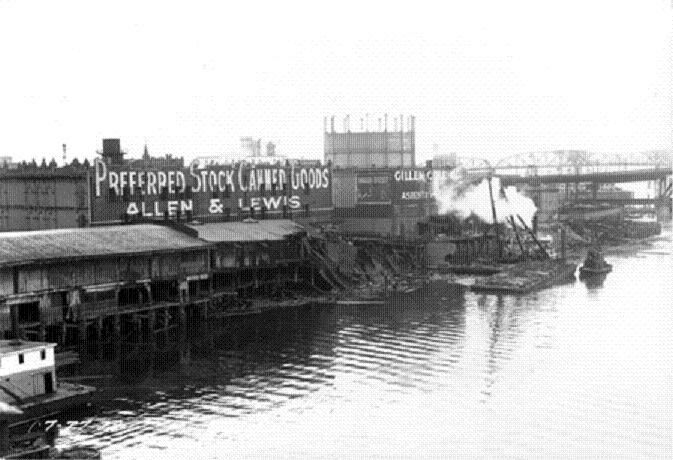
Portland waterfront near the Burnside Bridge, c.1925


From a WPA "Guide to Portland," of all things.

The wide thoroughfare North of Ankeny Street is "THE SKID-ROAD," known as a meeting place for itinerant workers from all over the country. In former days Burnside Street separated the rough North End "bowery" district from the more genteel parts of town, but now it is the southern boundary of a cheap mercantile district of lounging rooms for itinerants and numerous cheap hotels and flop houses. These are gradually being pinched out to make room for factories and wholesale warehouses. In 1905 Mayor Harry Lane, later United States Senator, clamped down on the women denizens, and scattered them to all parts of the city. Since then the city has had no restricted red light district.
Portland had a "restricted red light district?" No surprised, really. After all, what western U.S. town was not without its, uh, adult entertainments?

Portland, you dirty girl, you.

Wednesday, July 12, 2006

d.d. tinzeroes vs. the Transformers

I spill a lot of ink discussing 1986's Transformers: The Movie, in my first piece over at Reviewiera.


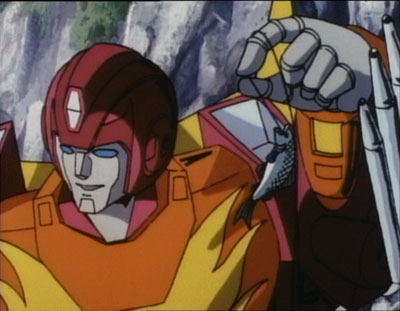
I always found the above image inexplicably disturbing. Actaully, "disturbing" is too strong a feeling. Just a sorta weird, "soemthing's off here," "whut da?" feeling.

Like, here's this gigantic, multiple-ton alien artificial life creation from an artificial metal planet1, dangling a Terran biological life form (a salmon? a trout? it’s a sizable fish by human standards, I think, if scale is ever consistent in Transformers) like a fly on a string. What's a human in his eyes? An intelligent guinea pig? Even giving the Autobots the benefit of being, at least, are benevolent, this still has a strange, sinister, overlordy tinge to it.

-d.d.

1 Cybertron: Presumably a "real" planet once, transformed by the Quintessons into a factory planet millions of years ago. They built a race called "Trans-organics", part-animal, part-machine, to serve them. Eventually the Trans-organics came to be beyond Quintesson control, and were placed in suspended animation in Cybertron's core (ladies and gentlemen, welcome to: "things I learned from the third season of Transformers!). The creation of the first versions of the Transformers soon followed, although they could not transform yet. Soon they were programmed to have intelligence, and perhaps unintentionally, feelings. Autobots and Decepticons are descended from the two basic classes of robot the Quintessons' built: industrial/commercial (Autobot) and military (Decepticon). Guardian robots, a third class, were produced to protect the Quintessons from their other creations. Eventually, a proto-Autobot known as A-3 built a device (the Matrix?), hidden inside his slave brand (the proto-Autobot insignia), that disabled the Guardians, and at last the Transformers (Autobot & Decepticon) rose up. The Quintessons fled into space to construct a new home world, Quintessa, and another slave-race of transforming robots, the Sharkticons, to serve them. They would remain uninvolved in Cybertronian affairs until Hot Rod & co. crash landed on Quintessa at the time of Transformers: The Movie.

Tuesday, June 27, 2006

Venture Brothers

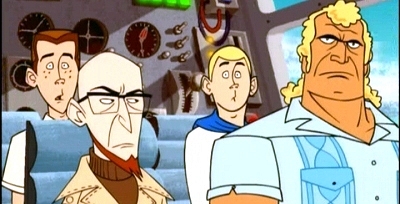
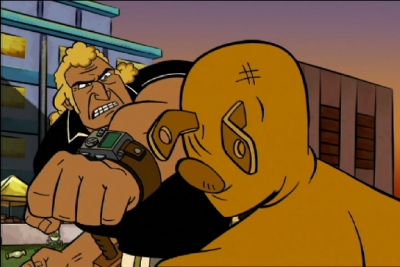
The first episode of the Venture Brothers I ever lay witness to was one Sunday night at the Jolly Inn, back when Jeff Bastard used to wage-slave there and when C. Collision still used to get intoxicated. Being a public house of the lower order, the television was always on. Invariably, the channel was frozen on Adult Swim, w/ closed captions. This was the medium of my first Venture Bros. exposure. Despite closed captioning, my usual distrust of all things Adult Swim was tempered by visual images so bizarre my interested was thoroughly piqued.
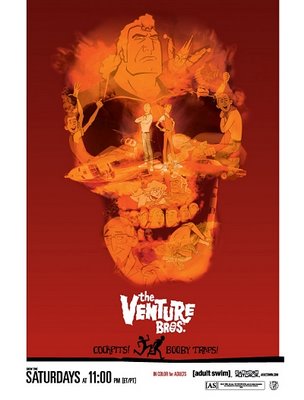
image hosted by BLOGGER

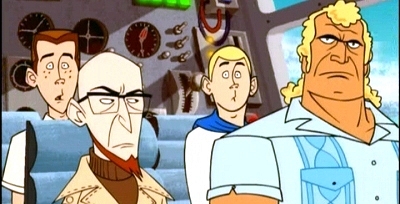
I experienced a second episode when aforementioned Collision and I grabbed a 6er on the way home from the more upstanding Basement Pub after it closed (it closes at 1:30, giving the intelligent inebriate one full hour before beer-thirty to procure after-hours entertainments). Upon viewing the opening credits with sound, it only took few stanzas into the theme for me to declare, "this is J. G. Thirlwell!"

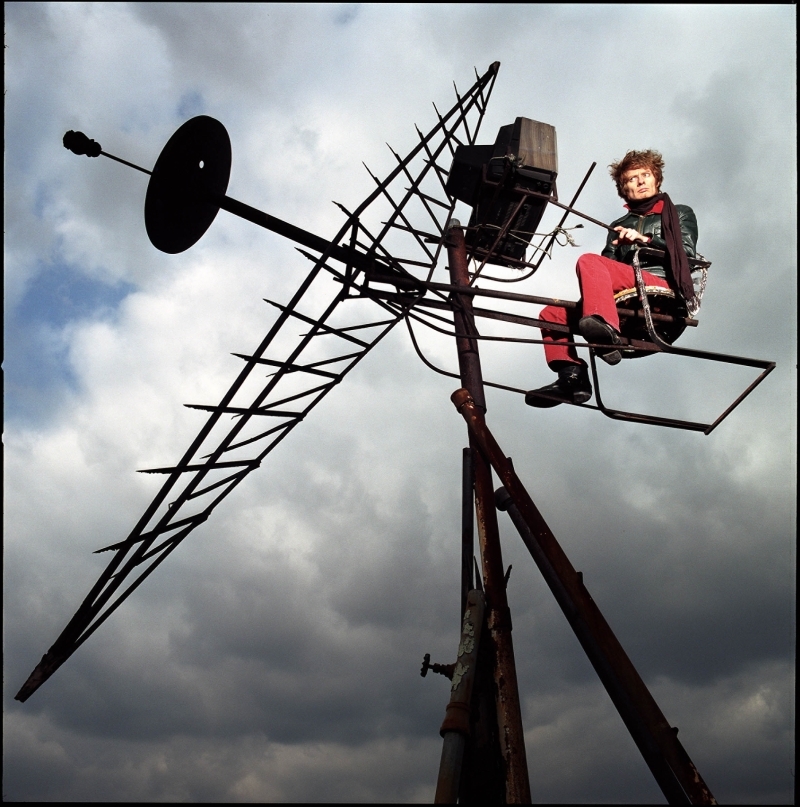
J.G. Thirlwell, of course, is a musical fave of mine since shadowy past days of high school. At the time I was an insufferably devoted NIN/Minstry fanboy and was looking for more of the same ilk. Thirlwell's work, all under the various Foetus monikers, was not the same ilk (nor, as it turned out, was PWEI, which also remains my other musical fave). I dabbled in several Foetus albums, but I recall the Sink album, consisting of old singles and various instrumental pieces, being the first to really get under my skin.
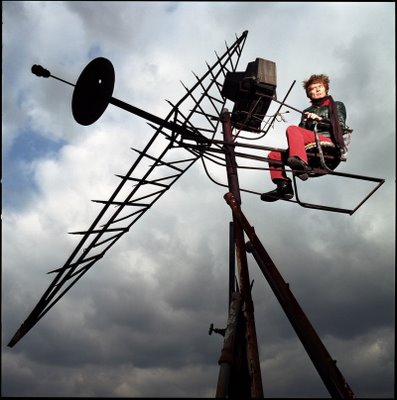
image hosted by blogger

Around my senior year of high school Thirlwell's first and only album for Sony came out: a Foetus disc entitled Gash. That album rocked. It rocked even more when I became a sexually frustrated college freshman, the de facto soundtrack to my year of dorm life. This fit all the better when Thirlwell interviewed and said Gash was about a breakup.

I believe I may have never seen another episode of the Venture Brothers on television, but Collision was way into the show, and would pass along tidbits when the fancy struck him. We both pined for the dvd release. Collision later related to me that investigations had revealed none other than Ben Endlund was also involved in the Venture Brothers as a writer as co-creator Jackson Publick's college roomate.
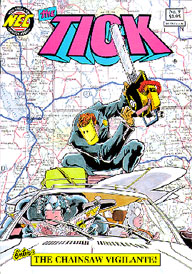

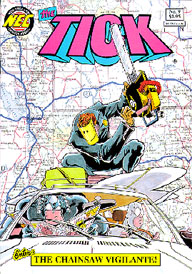
Ben Endlund is the artistic and writing genius behind the Tick comic book, which I had read in the even more mist-enshrouded and spooky days of middle school, and, of course, watched the still rather bizarre, surreal, what-the-hell-is-this-doing-on-TV-anyways Tick animated series on Fox when I was in high school.

When Venture Bros., Season One finally hit dvd last month, I didn't notice. I was busy setting myself up for heartbreak by falling for Dirk Nowitzski and Josh Howard. But when that was over, I was ecstatic to find out that a TV series I'd seen one actual episode of (the muted one doesn't count), scored by one youth hero, written by another, well then, dammit, I'm going to the viddy rental store!
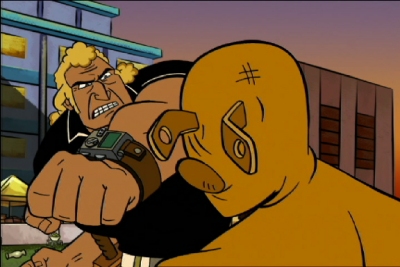
image hosted by blogger

13 episodes of bliss.

Friday, June 16, 2006

The Oaks Tavern.

(1905 – 1920s?)

The Oaks Tavern, located at the northwest tip of the Oaks amusement park, was a feature attraction of the park when it opened in 1905, serving Weinhard's beer for five cents a bottle along with a fine dining experience, a view of the Willamette and live music.


In as little as a year, however, the temperance crusade began to move against the Tavern. In 1906 an attempt was made to designate Sellwood a dry neighborhood. The measure failed in an county election that June, but in the wake of defeat it was reveled that the Oaks' Superintendent of Construction had paid for Oaks and OWP employees to stay overnight in a Sellwood hotel, the address of which they used to register as Sellwood resident voters. Certain prominent Sellwood landowners further colluded by swearing (falsely) to the veracity of the employees' resident status. Despite a grand jury indictment booze remained king at the Oaks.

In the following year however drunkards from the Oaks managed to accomplish what democracy could not. In the remaining months of 1906 an off-duty police officer threatened an employee with his revolver, and in another incident a inebriate attempted board a moving trolley and predictably miscalculated his leap, resulting his skull being crushed beneath the steel wheels. In 1907 management declared the Oaks dry.

The Oaks attempted to lift this ban in 1908 and again in 1909, although the City refused to grant new liquor licenses. It might seem that the third try was the charm in 1910 but the reality was that new owner John Cordray's local celebrity had more to do with the Oaks' new designation as "Portland's adult playground." But the looming national nightmare of Prohibition was clearly on the horizon and in 1914 the Oaks' went dry once more. By 1916 Prohibition was law in Oregon.

I'm not sure when the Oaks' Tavern was demolished. I can't believe that the building was that structurally long-lived in the first place. The Willamette flooded to varying degrees regularly and lack of patronage due to Prohibition would probably see the Tavern torn down prior to the second world war, if not the first.

Monday, June 12, 2006

Sunday, June 11, 2006

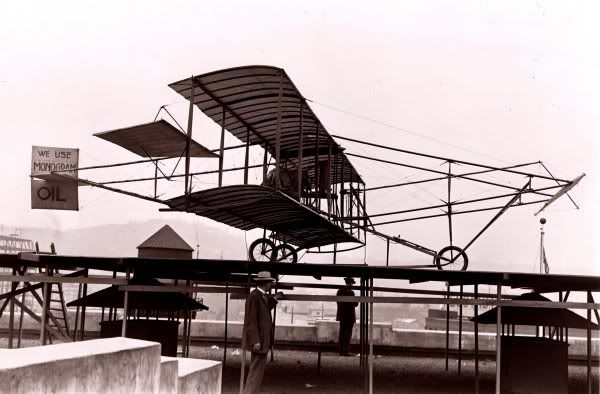
Silas Christofferson Flies from Roof of Multnomah Hotel.

(June 11, 1912)


Christofferson prepares for takeoff on ramp atop the Multnomah Hotel.


Silas Christofferson flew from the roof of Portland's Multnomah Hotel across the Willamette and Columbia rivers to Pearson Field in Vancouver in his 40-horsepower-engine biplane in 12 minutes.


Christofferson's biplane takes off from roof of the Multnomah Hotel.

Thursday, June 08, 2006

Willamette Shore Trolley.

A few colleagues and I sessioned upon the Willamette Shore Trolley a weekend past ago.

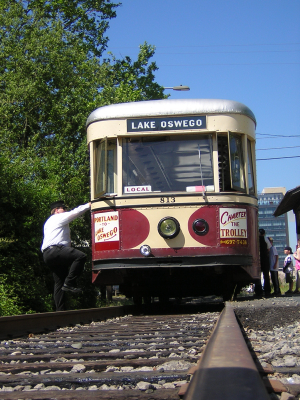
The 1932 J.G. Brill Co. "Broadway" Trolley Car (No. 813) is maintained and operated by the historical hobbyists over at the Oregon Electric Railway Historical Society, and the trolley fares (10bucks round trip, 6 one way) are a primary revenue stream for the Society.

The trolley has a schedule of sorts, although since this is most definitely a tourist and enthusasist's mode of transportation, the Conductors & Motormen are not adverse to running late. The trolley itself is comfy and airy, and rocks, sways, swings, creaks, squeaks, and rattles as it rolls down the old Red Electric tracks from SW Moody & Bancroft to downtown Lake Oswego. One fellow remarked the trolley was rocking him to sleep with its rhythmic swifting and swaying, which is notable if only because there are none of the bumps associated with riding a bus and a fraction of the noise.

The trolley itselfs sort of a queer-looking thing. My colleagues noted it was a blocky and ackward looking vehicle. I have to agree insofar as its definitely resembles little the what we think of as a "traditional" trolley, by which we're really thinking of just about anything built between, say, 1890 and about 1915 or so. It is these trolleys which grace the fronts of ready-made rice boxes and sit in family Italian restaurants.

photo hosted by flickr.


This later-day Broadway car, however, resembles something I'd expect to see in a Miyazaki film. It’s a strange breed that mixes something distinctively old (a trolley) with a lot of features I'd frankly expect to find on a 1950s autobus. Bizarre!