

Wednesday, May 03, 2017

Monday, August 24, 2015


Thursday, January 15, 2015
He's sheef p'lice.
DRUNK ON THE STREETS
-----
Napoleon Davis and Chief Barry Join in Debauch
-----
DISGRACEFUL SALOON BRAWL
----- Barry Said He Was Running the Town and Viciously Assaulted a Saloon-Keeper.
-----
The spectacle of the chairman of the police commission and his chief of police staggering along the streets in a drunken spree, shouting curses, brawling in saloons, destroying property and viciously assaulting unoffending citizens was furnished a number of people the night before Thanksgiving. Although Chairman Davis and Chief Barry may have forgotten all the circumstances of the episode, these are perfectly fresh and distinct in the minds of many witnesses, particularly the unfortunate victims of their assault.
-----
Napoleon Davis and Chief Barry Join in Debauch
-----
DISGRACEFUL SALOON BRAWL
----- Barry Said He Was Running the Town and Viciously Assaulted a Saloon-Keeper.
-----
The spectacle of the chairman of the police commission and his chief of police staggering along the streets in a drunken spree, shouting curses, brawling in saloons, destroying property and viciously assaulting unoffending citizens was furnished a number of people the night before Thanksgiving. Although Chairman Davis and Chief Barry may have forgotten all the circumstances of the episode, these are perfectly fresh and distinct in the minds of many witnesses, particularly the unfortunate victims of their assault.
Early
Thanksgiving eve Davis and Barry started out with the praiseworthy intention of
showing the town that they owned it.
After they made the rounds of the saloons and dives, leaving a trace of
overturned beer kegs, bicycle racks and signboards in their wake, and imbibing
all the liquor they could get free, the brought up about 1 o'clock Thursday
morning in a saloon on Morrison street, both ugly drunk, and looking for
trouble.
Banging the door open, they staggered up to the bar and demanded a
drink. It was furnished them. They they started for the private rooms in
the rear, one of which was occupied by two young men named Mannard and Lenner.
"Who's in this here room," demanded Barry.
"There are two young gentlemen there, chief," said the
bartender, civilly. "There are
plenty of other rooms."
"Do' wan' no other room; want this here one," said the chief.
"You'll have to take another."
"I'll do nothin' kind; I'll break door in," shouted Barry,
giving it a vicious kick.
This
brought the one of the occupants of the room to his feet.
"I
don't know who you are," said he, "but if you want this room worse
than we do, we'll get out and let you have it."
"Looker here, young feller," yelled Barry in a drunken rage,
"I'm chief p'lice, I'll git in there 'n show you who's runnin' this here
town." He threw back his coat and
showed his star.
"Thas' what he is," corroborated Davis, "He's sheef
p'lice. I'm cham'n p'lice. I'll stand 'im back. Don't give no jaw."
At this
juncture, William Anglin, who runs a saloon on Morrison street, near the corner
of first, and the bartender came running in, and took a hand in the melee.
"I
can handle him," said Anglin, and
he made a grab for Barry. The
chief, who is a powerful man, suddenly swung around and smashed Anglin on the
face, breaking his glasses into fragments, and sending him back into the
barroom.
"Leave me 'lone," he shouted, "I'm chief p'lice. I'll fix these here kids in this
box." He thrust his hand in this hip
pocket, and would have drawn his pistol, had not the barkeeper seized hi and
pulled him back into the barroom. A
crowd had in the meantime gathered, and by the united efforts of every one
present, Davis and Barry were pushed into the street. The next day one of the young men who was in
the box received a note of apology, signed by Barry. Anglin was paid $5 for his broken glasses,
which was a sufficiently large sum to purchase his silence.
Earlier the same night Davis and Barry came out of the Imperial, a
concert dive on Fourth street, between Morrison and Yamhill, and made the best
of their unsteady way around the block, overturning bicycle racks, piles of
beer kegs and everything they could lay their hands on. Every time a bicycle rack was reached David
would kick it over, and order Barry to pick it up and heave it into the center
of the street, which the latter would do with alacrity. The four sides of the block around which they
made their irregular course were strewn with smashed movables, and their course
could be traced a long way by the wrecks, whatever they were able to lay their
hands on. In the Louvre, at Fourth and
Alder streets, their boisterousness soon led to their ejection, as it did in a
number of other places.
Before
reaching the Morrison-street saloon, they made the rounds of the dives and
disreputable houses. It was the night of
Bud Smith's victory at the Multnomah Club, and the street was crowded with
young men, celebrating the event. Nearly
all of these met the drunken officials in their travels. Whenever the latter met any one whom they knew
they stopped and engaged in maudlin conversations, telling with great glee that
they owned the town, and were going to do what they pleased with it.
Several policemen met them, but the only one who had the courage to
advise them to go home was roughly told to mind his own business. At 2 o'clock a county official, who is a
personal friend of Barry, put the two drunks in a hack and sent them home. It was too late, however, to avoid a scandal,
although both Davis and Barry have been spending considerable time and money to
hush the matter up since.
There
have been no arrests.
Although recent publicity has lessened their patronage, the dives,
dancehalls and like places are still open, and undisturbed by the police.
At
First and Madison streets, a combination joint is run by one DeMartini, which
is the rendezvous of the toughest element in that section of the city. Downstairs is a bar and a disreputable show,
in which women take part, in open defiance of the law, which forbids womenin the
same room with a bar. Above is a crap
and stud poker game. Here thugs and
toughs congregate in large numbers, and not a night passes that the place is
not the scene of a disgraceful drunken brawl.
Policement wander in and out of the place and drink at the bar.
A
place known as the Imperial, on Fourth street, near Morrison, is nightly filled
with women, who take no trouble to conceal themselves behind the curtains of
the boxes in which they are ranged. A
close inspection of these boxes will reveal the presence of numerous young
girls not of their teens, who have been lured thither before they know the character
of the place, and who have been corrupted till they enjoy the entertainment.
The
proprietors of the dancehalls in the North End constantly visit such places of
theses in search of women to fill their dives.
These men prefer young girls, who are willing to pay them large
commissions to dance in their resorts.
Girls whose first lessons in evil are taught in concert halls like the Imperial
invariabley find their way sooner or later to the dancehalls of the North End,
and are associated with the worst element to be found in the city. All such places are frequented by the police,
and not the slightest effort is made to keep young girls out of them.
-Oregonian. December 9, 1897.

Patrick J. Barry was Portland's Chief of
Police from June 9, 1897 to July 2, 1897 (just 23 days!), so the date of this
article (December 1897) and purported date of the drunken foray (day before
Thanksgiving, 1897), both months after the end of Barry's short tenure as chief,
means Barry was carrying on about being "sheef" long after it no
longer being the case (but Barry flashes his "star" to get his way?). Portland's then-Mayor Pennoyer appointed four police chiefs during his term (1896-1898). His
successor, Mayor Mason, replaced the entire police force, its chief, the janitor, and the board
of commissioners, including… Napoleon Davis.
Davis knew Mason would clean house and forced each the Portland patrol to
donate $25 a month to war chest to defeat Mason in the election. He collected $2,500 and instead kept it all for his
own personal use "to buy big fat cigars" (see Portland's Finest, Past and Present (2000) p22).
Sunday, December 28, 2014

Wednesday, December 17, 2014

Thursday, October 16, 2014
Fritz Leiber

photo:flickr(WillHart)
Been thinking about ol' Fritz the last few days - mainly the excellent Swords of Lankhmar which regards the attempted takeover of that fair polity by its rodent population.
Wednesday, August 27, 2014

Friday, August 22, 2014
Beachy Reading

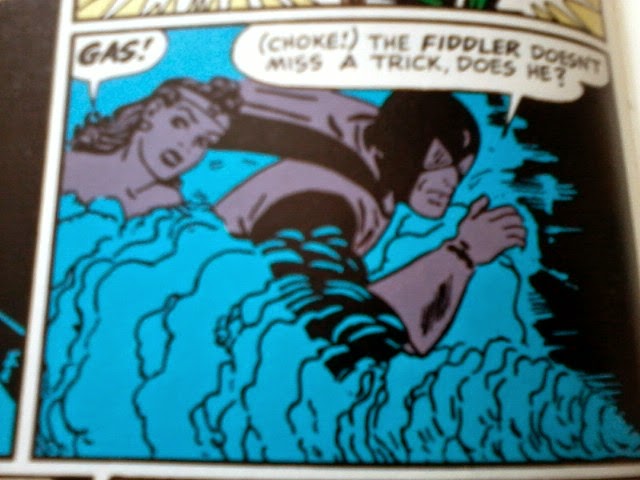


We went to the coast for several days and I grabbed a bunch of golden age archive editions from the library to give the kids something new to look at for the drive out and back. Included was a volume of Wonder Woman, Batman, Plasticman, and All Star Comics. I've never been terribly impressed by DC titles but thier Golden Age stuff really works for me. The above sequence of Doctor Mid-Nite and Wonder Woman getting trapped under the Liberty Bell and thier rather silly but logical solution to this plight seems as close to an embodiment of the Golden Age zeitgeist as I've ever seen.
Friday, August 15, 2014

Wednesday, July 30, 2014
Criticism Made Freely
In 1913 New York City's Buerau of Municipal Research came to Portland and reviewed the city's government and services. It published its results in a series of reports as they were completed, and summarized the results on May 4, 1913 in the Oregonian, only shortly before an election where voters would decide whether to adopt a new city charter based on the Galveston plan. Here's some excerpts.

The new city charter, which remains our present-day city charter, passed by a narrow margin of 722 votes [I have a citation for this - I will update later with it] (it was also the first election after women's suffrage in Oregon). Its passage should not be weighted too heavily on the Bureau of Municipal Research's findings - rather eastside Portland discontent with under-representation under the existing ward system is a more likely culprit.[I have a citation for this, too] There were 10 wards with 4 on the eastside and 6 on west, despite the eastside being far more populous by 1913 than the west.

The sentiment is echoed by a postscript from Oregonian editorial board regarding the Bureau of Municipal research report, after passage of new city charter:

Here follows the full scan of the Bureau's summary from May 4, 1913:

- "No centralization of power could possibly afford greater opportunity for wrong doing than the conditions which actually obtain in thecity's legislative body at the present time."
- "The Police department is so inefficient that to list the things it hasn't but ought to have is to describe a modern police department."
- "Control over contagious diseases is wholly inadequate. One-quarter of the city's tuberculosis cases are not reported. Venereal diseases are not reported at all. Cases are often released from quarantine by telephone or verbal order."
- "The Council, particularly, has assumed dictatorial powers in the granting of special [building] permits, although wholly incompentent to pass judgment understandingly upon such technical engineering questions. Special permits mean special privileges for a few"
- "Provision has not been made for maintaining all streets by city labor." [100 years of potholes]
- "The Auditor's financial control is no control. It consists merely of his being informed what has been done after it has been done."
- "The City auditor has no means of knowing whether the city received from the county all of the taxes to which it is entitled."
- "Although water revenues amount to more than $750,000 a year, the City Auditor has no accounting or auditing control thereover."
- "Scientific budget making in Portland is handicapped by the present charter, which limits each of the city's principal functions to a certain perscribed tax levy. The Council should be able to apportion each year's funds according to the current needs of each department, bureau and office, and not be compelled to adhere to the arbitrary schedule fixed 10 years ago."
The new city charter, which remains our present-day city charter, passed by a narrow margin of 722 votes [I have a citation for this - I will update later with it] (it was also the first election after women's suffrage in Oregon). Its passage should not be weighted too heavily on the Bureau of Municipal Research's findings - rather eastside Portland discontent with under-representation under the existing ward system is a more likely culprit.[I have a citation for this, too] There were 10 wards with 4 on the eastside and 6 on west, despite the eastside being far more populous by 1913 than the west.
The sentiment is echoed by a postscript from Oregonian editorial board regarding the Bureau of Municipal research report, after passage of new city charter:
- "The same charter, last November, in competition with another commission charter, gained 48.08 percent of the vote case on the issue. In the recent election, with no competition, it secured 50.44 per cent of the vote cast."
- "These experts told us a large number of things we already knew and had been discussing for months and even years. They were not employed by the city of Portland, as might be readily inferred from the [recent advertising] leaflet, but by a self-appointed committee, whose membership in large part is yet unknown to the public. The work of the bureau was no needed, and served principally tocomplicate a contest between rival candidates for office. There is suspicision that it was brought here for that purpose. Does anybody remember what the bureau reported, except that it placed all blame for municipal shortcomings on the old charter and by implication excused from blame city officials who were seeking re-election?"
So maybe the whole report was a publicity hit job? It certainly reads like one. And if a hit job is what the citizens group wanted then the Bureau certainly delivered the goods. Here follows the full scan of the Bureau's summary from May 4, 1913:
Subscribe to:
Posts (Atom)